
On May 1, 2026, over a million people, workers, students, and families, made their voices heard in actions across the country to demand that we put workers over billionaires. Many of the actions demanded no business as usual, often using the May Day Strong slogan “No School, No Work, No Shopping.”
The majority of demonstrations brought together labor unions and community organizations united to defend immigrant workers, protect our right to organize, end governmental surveillance, and insist public resources be used to fund public services like childcare and healthcare, not war.
The return of attention to May Day, beyond the organized left, is important for the broader anti-Trump resistance, but also for building a millitant fightback on working class demands.
The make-up of the various actions varied in different locations. But in many, the issue of the war was central, as even the Associated Press headlined: “What to Know about May Day demonstrations as workers face rising energy costs due to Iran war,” reporting that activists worldwide demonstrated for peace, higher wages and better working conditions as many workers grapple with rising energy costs and shrinking purchasing power tied to the Iran war.
Actions
Scheduled school walkouts and a high number of teachers taking personal days led school districts in Georgia, Illinois, North Carolina, Oregon and Wisconsin to close for May Day.
In the city where May Day began, The Chicago Teacher’s Union, an initiator of the May Day Strong coalition, won May 1st as a declared “Civic Day of Action.” Thousands of Chicago students went on field trips instead of going to school, and learned about civil rights and election defense from historic organizations like Operation PUSH, just days after the Supreme Court gutted the Voting Rights Act.
In North Carolina, nearly 20 school districts canceled classes ahead of the protests because so many teachers took personal days to participate in May Day events statewide, especially the huge “Kids Over Corporations” rally in Raleigh, called by the North Carolina Association of Educators. This was one of the largest labor actions ever in the state, which ranks last in school funding.
The Sunrise Movement, a youth-led advocacy group focused on climate change, garnered the pledge of 70,000 students to walk out from hundreds of campuses across the country, and estimated 100,000 students would take part
There was a lot of creativity throughout the different demonstrations.
In Washington, DC, activists blocked a freeway exit by the American Petroleum Institute (API) and American Gas Association (AGA), demanding lobbyists stop driving climate collapse. Participants report the main protest march there stretched for 20 blocks.
SEIU Healthcare Illinois & Indiana led protests at Amazon locations, demanding the company pay higher taxes and fund community services. Childcare and home care workers accused Amazon of exploiting labor while failing to pay its fair share, demanding to “tax the rich” to fund healthcare and education.
Nurses in Maine demanded that Maine Health ends its contract with Palantir (which also contracts for ICE and Israel). Nurses in New Orleans picked May 1st to start a 5-day ULP (unfair labor practices) strike in order to protect standards of patient care and working conditions.
In Minneapolis, housekeepers and engineers who are members of UNITE HERE Local 17 went on a one-day strike, seeking a $3-raise and sick days and a fair contract they have tried to negotiate since July.
While not able to legally call a strike, the ILWU chose this May 1st as a union meeting day, pulling workers from operating ports up and down the west coast.
In Seattle, labor rallied and marched, and hosted a May Day program that included IAM District 160’s Maximo Londonio, who survived detention inside the Northwest Detention Center and has continued organizing to defend immigrants targeted by inhumane immigration enforcement.
Large demonstrations against ICE happened across California. There were 26 scheduled events in the Los Angeles area, including a march of around 20 thousand with community organizations and union contingents.
In New York City there were several small events before the afternoon May Day rally endorsed by the NYC Central Labor Council (AFL/CIO), which usually only supports the Labor Day parade. Amazon workers and supporters rallied early in the day, and marched to Jeff Bezos’ penthouse. At lunchtime, over hundred protesters symbolically blocked every entrance to the New York Stock exchange, with many pre-planned arrests. Large turnout from several unions ensured the main march was the largest May Day march since Occupy Wall Street brought the left and unions together on May Day 2012. While in other cities organizers included the “No School, No Work, No Shopping” call in the messaging of May Day events, in New York City a risk-averse union leadership and fear of the Taylor Law kept that language off the official announcements. But activists picked it up anyway, and ran with it.
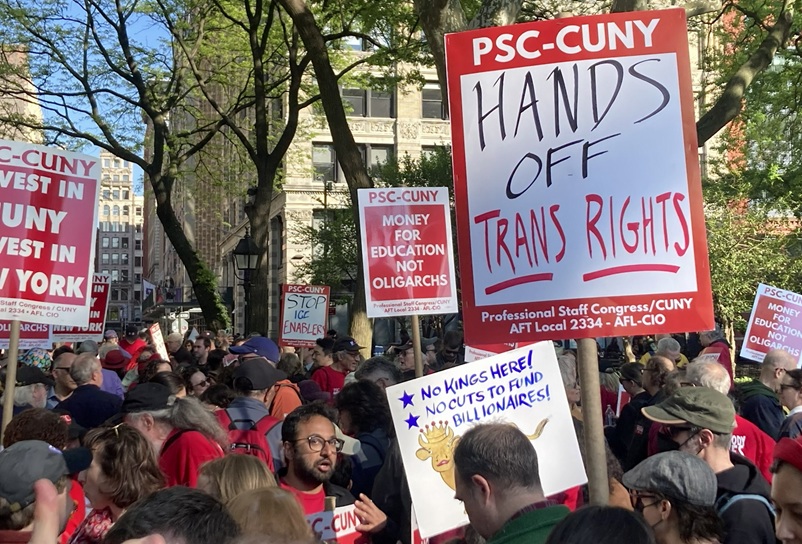
chanting on a range of issues.
Building Working Class Activity
Of course, the recent No Kings marches were much larger, in New York and nationally, but May Day was a step forward in involving unions and explicitly raising class politics. Even more than the call for May Day strikes in 2028, this was inspired by the struggles in Minneapolis/St. Paul. Adding to already impressive community organizing against ICE, earlier this year the twin cities saw significant escalation of union involvement, and massive unofficial absences from work in the over 70,000 people protesting the racist and murderous actions of ICE and Border Patrol.
Within the May Day Strong movement, there are also attempts by more mainstream forces, who previously would have ignored May Day, who joined the activity, but wanted to turn it into another (smaller), “No Kings” ajacent anti-Trump movement. Some ultimately want to steer “the resistance” into voting for Democrats in the mid-terms. This focus would be disastrous for the movement. It is not enough to defend a hated status quo, and not even an effective way of opposing Trump’s excess. May Day showed an independent, working class coalition is possible, but its strength still needs to be built.
After May Day 2026, organizing efforts are pivoting toward sustaining momentum through long-term labor actions, including “Solidarity September” protests; supporting “Plan 2028” to align union contracts in preparation for a major labor mobilization and May Day 2028 “general strike;” and building infrastructure for “strike-ready structures” and workplace mentorship via groups like the Emergency Workplace Organizing Committee (EWOC) which is a project of the United Electric, Radio and Machine Workers of America (UE) and the Democratic Socialists of America (DSA).
Following the “No Kings” and May Day protests, organizers are also pushing rebuilding neighborhood and grassroots networks, and longer-term “non-cooperation” tactics.
The broader mobilization is welcome. But within that we should not give up independent working-class organization, which must combine economic and political aims. Ongoing independent organizing (against ICE, in defence of trans people, against the war in Iran and Zionist genocide, etc.) is just as important, along with workplace struggles.
In the signs and chants on May Day, in the attempted blockaid at Wall Street, and elsewhere it was apparent many are seeing the roots of our problems in our economic system, but at the same time are being pulled in a more limited anti-Trump direction. As the mid-terms approach, there will be more pressure to accept the normative capitalism and imperialism of the Democratic party. Much more than the No Kings marches, May Day actions give socialists space to argue for the more systemic changes we need, and point to the latent power to win them.
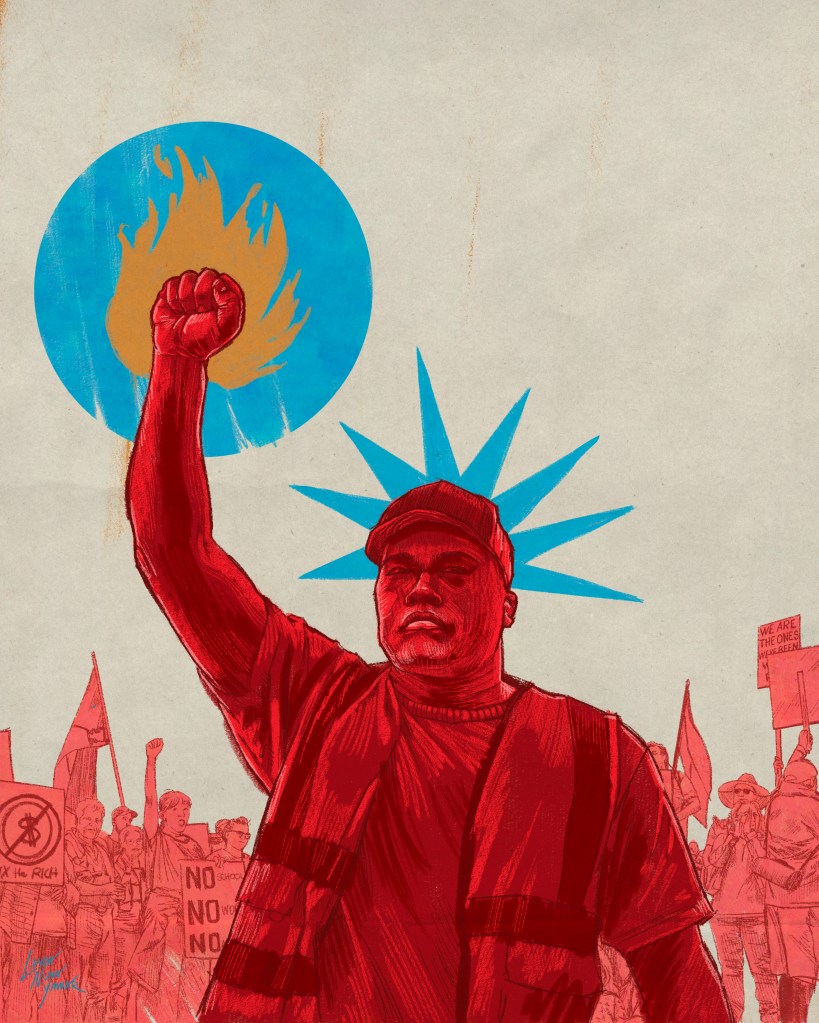
Racist attacks on Civil Rights
What is important is the focus on building worker solidarity and how cynicism has grown about the limitations of elections to solve our crisis.
However I do want to make mention of a horrendous recent Supreme Court decision, Louisiana vs. Callais.
On April 29, 2026, the U.S. Supreme Court executed a devastating blow to the Voting Rights Act and an outright attack on the fundamental freedoms of working people. The decision strips Black and Latino voters in Louisiana of having a fair say in their elected representatives, and will be used to further hollow out Americans’ voting rights across the country.
- The Voting Rights Act of 1965 (VRA) was passed to correct centuries of discrimination that prohibited Black Americans from voting. It arose from civil rights activism and bloody resistance, especially in the South.
- The VRA was made up of several sections, including measures to ensure that every vote be counted, to stop state legislatures from passing discriminatory laws, and to guarantee congressional representation of voters of color.
- Since the moment the VRA was passed, there has been a single-minded effort and strategy to destroy it. In 2013, in a case called Shelby County v. Holder, the Supreme Court killed a critical part of the law that required states with historic and ongoing discrimination against Black and Brown voters to “pre-clear” any new voting laws that wanted to pass. The decision rolled back decades of progress of holding states accountable for discrimination in voting laws.
- Once that provision was gone, discriminatory voting laws exploded across the country, and states have been attacking our voting rights with increasing frequency. The remaining parts of the VRA were one of the last and most important federal laws that protected our ability to have our votes counted and our voices heard.
- With a 6–3 decision, the majority of the Supreme Court gutted the last remaining leg of the VRA. They allowed states to create congressional district maps that lock out Black, Brown and Native Americans from fair representation by striking down a Louisiana law that was intended to ensure equal representation of Black and Brown voters in the state.
- The court has knocked down the most important and effective part of the law, allowing states to draw maps that result in discrimination and have the impact of dilluting—if not silencing—voters of colors’ voices in Congress.
So at the same time we have to argue that elections will not empower the working class to create the world we need, we must defend civil liberties and the continuous racist attacks on our civil rights. The fight ahead is clear! From what we saw on May Day, there are large numbers in this country that know and understand these continued challenges and are ready to keep up that fight.
-Virginia Rodeno

