Eric Fretz looks at the case of Palestinian activist Mahmoud Khalil, the role of Columbia University and the Trump administration, and describes recent demonstrations for his release. He argues the case could set a threatening precedent, but we are not living under a fascist regime, and that the activist campaign to free Khalil can unite issues, win his release, and spark a larger resistance to Trump.
Columbia graduate Mahmoud Khalil is still being held in a notorious Louisiana immigration detention center. He was arrested on March 8 at his home in New York for having organized protests at Columbia University against the genocide in Palestine.
On March 12 a court case in New York (with Khalil still held in Louisiana) ruled that he cannot be removed until his deportation case is heard. This detention — of a legal permanent resident who faces no charges of any illegal activity — is an escalation of the repression of the Palestinian solidarity movement, an escalation of Trump’s deportation threats, and a threat to free speech and civil liberties to all of us.
As the Palestinian Youth Movement New York Chapter wrote: “The attempt to silence dissent here in the United States is an integral part of the US–Israeli genocidal war on Palestine. As Israel doubles down on its criminal siege of Gaza, where it has now blocked all aid and cut off electricity, the Trump administration is escalating its efforts in combating voices standing for justice – like that of Mahmoud’s.”
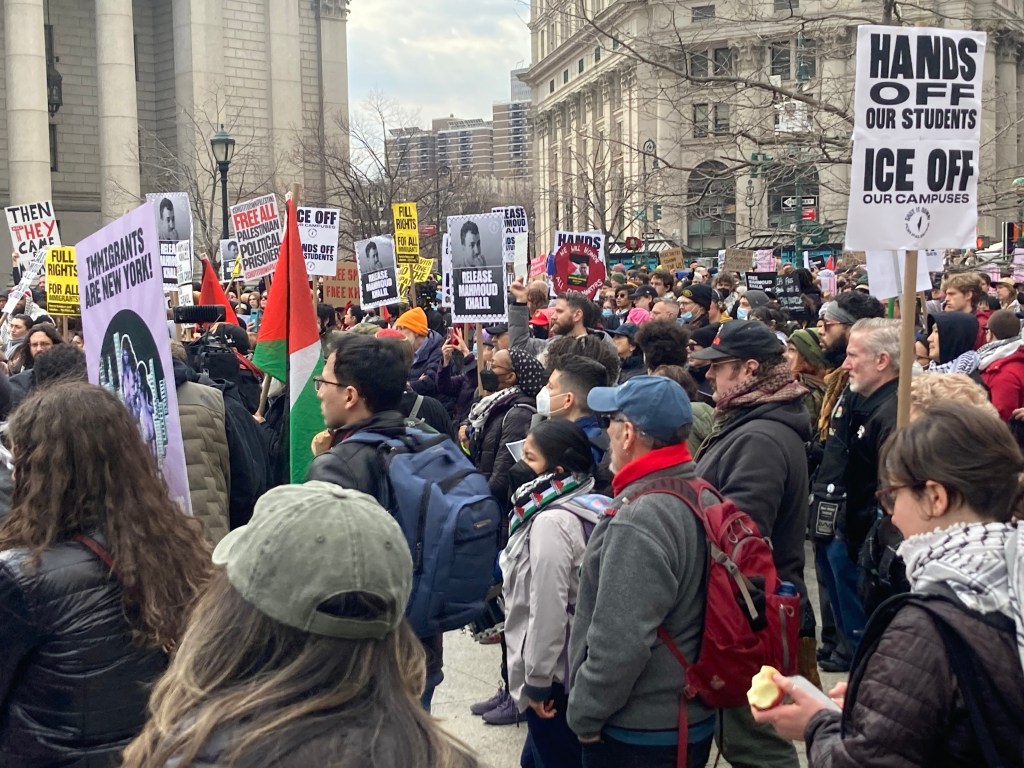
Khalil’s kidnapping has sparked demonstrations and campus walkouts across the country and a march of thousands in New York, followed by thousands in front of the courthouse on March 12, and continued demonstrations in the days after. At the time of writing, over 3.5 million people had signed a petition for his immediate release.
Arrest and detention
As a graduate student at Columbia Mahmoud Khalil played a role in the campus encampments against the genocide in Gaza. He was a patient practitioner of non-violent resistance who served as a negotiator between students and administration, which made him a public face of the movement.
On March 8, four plain clothed ICE agents entered the lobby of his university-owned building to apprehend him. They showed no warrant to his pregnant wife, a US citizen, and told her they were revoking Khalil’s student visa. When told he was not on a student visa, but rather a permanent resident with a Green Card, the agents initially looked confused. But after a phone call they said they would revoke that as well. Legally, only an immigration judge can revoke a Green Card.
A Department of Homeland Security spokesperson later said the arrest was “in support of President Trump’s executive orders prohibiting anti-Semitism.” They signaled the arrest was directly connected to Khalil’s role in the protests, alleging he “led activities aligned to Hamas, a designated terrorist organization.” Khalil has never supported Hamas, received instructions from it, or had any connection with the organization. By DHS’s standards, any person protesting against the occupation of Palestine in any way would be a target.
After initially being placed in detention in New Jersey, Khalil was moved to a facility in Louisiana. Moving apprehended people away from their families and lawyers is a common form of retribution that disrupts their defense. He is also more likely to appear before a Trump-friendly immigration judge in Louisiana, who would revoke his Green Card if asked. Many worried that Khalil would be quickly removed from the country, but a New York judge temporarily put a stay on his deportation.
Legal case
Khalil’s lawyer, Ramzi Kassem, said the government’s case “is absolutely unprecedented,” and initially said “we don’t believe it will fly in court.” One White House official admitted to the Free Press that the charge “is not that he was breaking the law.”
Despite the smokescreen of “aligning” with Hamas (which has no legal meaning), the only reason provided in court for his deportation is Secretary of State Marco Rubio’s claim that his work may have “potentially serious adverse foreign policy consequences.” A little-used clause of the Immigration Nationality Act of 1952 allows for deportations on these grounds, but it has never been used to violate the first amendment and stifle free speech.
Tellingly, the architect and co-sponsor of that 1952 regulation, Nevada Senator Patrick McCarran, was an ally of J. Edgar Hoover and Senator Joseph McCarthy known for his antisemitic stance, and portrayed Jews as Soviet agents and “subversive rats that need to be kept out” of the country.
As Elie Mystal argues in The Nation, “successful dictators make their actions “legal” through iron-fisted control of both the courts and whatever ineffectual legislatures they allow to exist. Trump is no different.” What the state attempts, and how the judges rule, are political decisions which can be affected by pressure from the Trump administration on one hand, or a mass and disruptive movement on the other.
“Antisemitism”
Just as he has had no connection with Hamas, there has been no documentation of any antisemitic statement or action by Khalil. “It is utterly despicable that they are carrying out this authoritarian lurch under the guise of fighting for Jewish safety,” wrote the Jewish organization If Not Now.
It should not have to be said that antisemitism is a form of racism, is inexcusable, and needs to be fought whenever it is encountered. There is a large concentration of antisemites among Trump’s followers, including in the Christian Zionists pushing this attack on Palestinian rights.
The Trump administration has cut $400m in funding to Columbia following pro Palestine demonstrations there. As Columbia professor James Schamus wrote “the excuse they are using to destroy the institution—that Columbia is incorrigibly antisemitic—is, of course, the exact opposite of what is happening. They are coming after Columbia precisely because the University is [to Trump’s antisemitic MAGA base] …an emblem precisely of Jewishness: it’s “globalist,” “cosmopolitan,” New York-based, “liberal,” etc.” The false conflation of antisemitism and anti-Zionism by Columbia itself has contributed to this canard.
Columbia’s role
Columbia, home of waves of student protests since 1968, has been especially repressive to activism over Palestine. They called in the cops on the peaceful Gaza encampments after only four days, with over 100 arrests, and cops later violently attacked a building occupation.
Columbia’s president put up no resistance to McCarthyite senate hearings into claims of antisemitism and simply did their bidding. When students were exonerated of charges under the Student Conduct Code established after 1968, the university set up a secret disciplinary process. A number of students were then disciplined, even expelled, over demonstrating or anti-Zionist speech. More students have since been suspended or expelled, and graduates had diplomas revoked, sparking another pro-Palestine protest outside the university gates.
Now, despite claims of standing up for student safety, they are not speaking up for their abducted student. In fact, the Forward reports some Zionist members of the University board called officials in the Trump administration to deport Khalil. Khalil himself wrote to the university just days before his arrest imploring them to intervene and protect him, as he feared for his life.
Among the victimized students was Grant Miner, President of UAW Local 2710, which represents thousands of Columbia student workers. He was expelled and fired the day before contract negotiations with the university were scheduled to start. UAW Local 2710 said it was “mobilizing a response” to this “grave injustice.” This should make it easier to bring the strength of the union movement into the campaign for justice for both Khalil and Miner. Firing the union president should be considered an unfair labor practice, which would justify a strike.
Protests
Monday, March 10 saw large crowds in New York’s Foley Square. Organized largely by Shut It Down for Palestine, there were also speakers from Jewish Voice for Peace and different immigration, civil liberties, and socialist groups, and campus unions. Around 2,000 marched, blocking rush-hour traffic, up to Union Square. On the same Monday, many Barnard and Columbia faculty spoke outside Columbia’s School of the Arts building in support of Khalil.
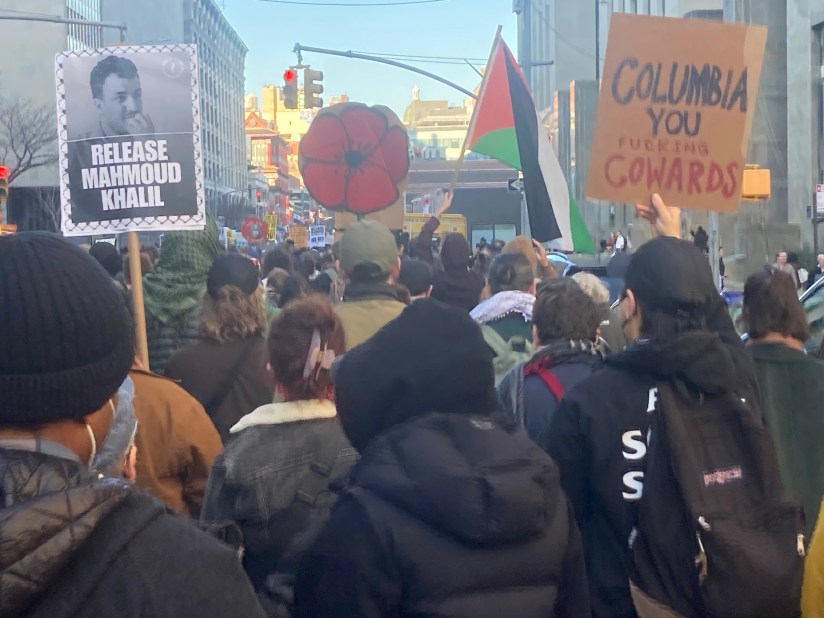
The next day saw multiple demonstrations. Columbia students walked out of classes. Many members of the banned Students for Justice in Palestine and Jewish Voice for Peace wore red T-shirts saying “Jews Say ICE Off Campus.”
That afternoon NYU students joined Students for Justice for Palestine chapters from several colleges for a rally in Washington Square Park. A professor with NYU Faculty and Staff for Justice in Palestine said the arrest was blatantly illegal, “If the Trump administration for one second is allowed to get away with it, then there’s really nothing that can stop the officers of the state from doing anything with any of us.”
Over a thousand gathered on the morning of March 12 for his court hearing. Khalil’s legal team announced there had been no decision on his release yet, but the pause on his deportation was reaffirmed. They told the crowd the mobilization for him made a real difference to Khalil’s morale, but also affected the decisions inside the courthouse. They said Trump is trying to stifle protest, but the crowds show he didn’t succeed.
In a surprise action the next day, more than 100 were arrested as over 250 from Jewish Voice for Peace occupied Trump Tower on Fifth Avenue, chanting “Free Mahmoud, Free them all.” They turned the ghastly gold interior red with their T-shirts which read: “Jews Say Stop Arming Israel” and “Not In Our Name.” Large banners read “Fight Nazis Not Students” and “You Can’t Deport a Movement.”
On the weekend of March 15-16, there were more coordinated demonstrations from New York to Los Angeles, and many in between. All combined “Free Khalil” with issues of Palestine, Immigration, and defense of protest in the US.
Immigration
Trump campaigned on mass deportations, repeatedly equating immigrants with criminals and terrorists. With Harris and the Democrats echoing the “crisis” rhetoric instead of challenging it, this has had an effect on public opinion.
The increase in ICE activity has sent fear through immigrant communities, but also resistance, and Trump is reportedly upset there are not yet increased numbers of deportations for the headlines. A high-profile deportation would be a sop to his anti-immigrant base. But mobilization over the injustices of the case could also be a boon to the movement for immigrant rights.
Threats to civil liberty
“This seems like one of the biggest threats, if not the biggest threats to First Amendment freedoms in 50 years,” said Brian Hauss, of the American Civil Liberties Union. “It’s a direct attempt to punish speech because of the viewpoint it espouses.”
Yet Yousef Munayyer, a senior fellow at the Arab Center Washington DC, was also correct when he said “This arrest is an escalation, but it’s certainly not new. This is part of a pattern going back years, where pro-Israel groups have tried to find ways to penalize advocacy against Israeli policies through a combination of legal and extra-legal means.”
Dima Khalidi, founder and director of Pal Legal, warns that Universities “instituting policies that create ideological and intellectual strangulation on Palestine—which get more bipartisan support than any other issue—provides the blueprint for doing the same to discourse, scholarship, and teaching on race, gender, climate, and other critical issues that Trump and his allies are already targeting.” And this was written before the government’s authoritarian demands on Columbia, which go beyond what we saw in the McCarthy era.
Signaling a wider attack, an unprecedented letter from the Trump administration demands the university “begin the process of placing the Middle East, South Asian, and African Studies department under academic receivership for a minimum of five years” giving a full plan in a week. In addition, it ordered giving campus security police functions, and adopting a definition of “antisemitism” that includes “anti-Zionism.”
In the rallies for Khalil, many speakers referred to Trump’s actions as “fascism.” The fear of this administration’s direction is understandable, and this is not the time to quibble over terminology. But Trump can still be resisted; he has not been able to destroy all opposition in the manner of a fascist regime. Extra legal repression from the State is not new in the United States. Understanding that is important to how we organize and fight back against this threat.
All out for Mahmoud Khalil!
The abduction of Khalil is an escalation of threats to free speech and civil liberties and would normally not stand in court. But the Trump administration is now trying to force through many things that would not stand in court. His recent deportation of Venezuelans to El Salvador, despite a federal judge’s injunction, shows that he does not care what the courts say.
We need to show resistance is not dampened down, but exploding. Despite the outrageous legal argument for Khalil’s deportation, it is possible they could find a Trump-friendly judge who would follow through on the deportation and create a terrifying precedent.
But continuing this wave of resistance could also win his freedom. It is up to us to turn a defeat of Trump on Khalil’s deportation into the spark for a mass movement against the Trump agenda and against this imperialist system. All out for Mahmoud Khalil!
Eric Fretz
 Marx21 US