
Victor Fernandez reports from Los Angeles on the recent Supreme Court ruling which codifies ICE’s unfettered racism — and opens the door for profiling by law enforcement elsewhere in conjunction with the Trump administration’s attacks on civil rights. But Victor also argues that the Fourth Amendment never really guaranteed those rights, court decisions are not the final say, and we must recognize the radical political shift with masses getting involved in facing off against actions by ICE and other repressive arms of the state.
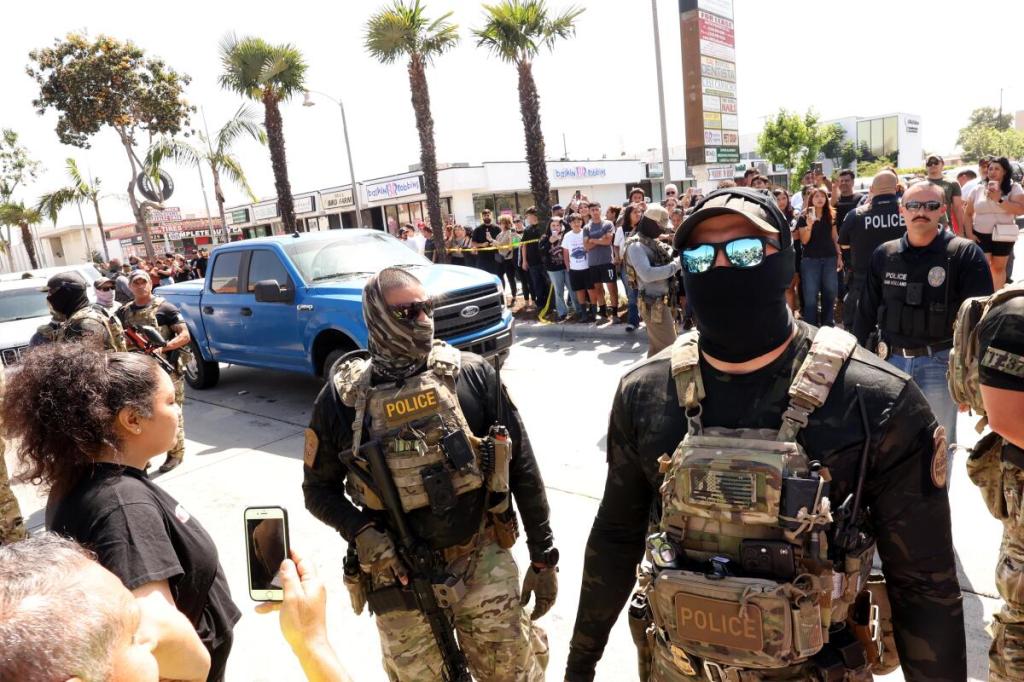
On Monday, September 8 the Supreme Court struck down the Temporary Restraining Order (TRO) passed by a US District Judge in July. The order was designed to prevent ICE from racially profiling people to detain and the court’s decision to overturn it dangerously protects the agency’s overt racism.
The TRO was a result of lawsuits brought on by immigrants’ rights groups and individuals affected by the ICE (Immigration and Customs Enforcement) and DHS (Department of Homeland Security) raids in Los Angeles which began in June of this year.
It specified that ICE and other government agencies could not use a person’s race, ethnicity, spoken language, place of work, or area of congregation as a pretext to stop them. In other words, they could not racially profile people of color as a basis for arresting them for deportation, which is exactly what ICE has been doing.
Aside from being a legal setback to the immigrants’ rights movement, this decision opens the door for racial profiling by law enforcement more broadly. This has been a major point of contention for not only immigrants’ rights activists, but for movements fighting against police brutality. This is also dangerous because it is a major violation of the Fourth Amendment, which protects against unlawful searches and seizures.
Racism and repression
Immigrants in this country are not only scapegoated and exploited, but like many maligned groups under the Trump administration, they are used as an excuse to increase the powers of the oppressive state. Trump used the excuse of the immigrant rights protests to mobilize the National Guard and the Marines into Los Angeles. This evolved into the DC takeover and the threatened federal takeover of Chicago.
While protests and resistance have pushed back against this, Trump’s fallback plan is to saturate these areas with ICE raids. This is something he knows he can get away with. However, the message is clear, the attacks on immigrants is only a prelude to a much deeper assault on all his opponents. People need to stand in solidarity with immigrants because they are coming for us all.
ICE was already violating people’s Fourth Amendment rights before this restraining order. ICE and DHS are there to enforce court orders of deportation and apprehension. Thus, they require a warrant or reasonable suspicion. It is illegal for them to pick up people from the street, trespass onto private property, and basically kidnap people they suspected of being here unauthorized, especially since they never even announce themselves as federal agents. The fact that they were targeting a primarily Latino group of people made it even worse.
The Supreme Court decision basically codifies this illegal practice. The agents understand this. This is why they hide their faces and don’t provide badge numbers, they don’t want to face the consequences of their actions, which they know are illegal.
Even with the TRO in place, raids continued in Los Angeles. Home Depots get raided on a regular basis. People are still stopped and picked up from the street without warrants or credible suspicions. It’s quite telling that the main excuse for going after the undocumented is that they broke the law. However, ICE/DHS break the law with every arrest and deportation. This has been a pattern of the Trump administration, where if cases go their way, they fully back them. But if they don’t, they have no problem flaunting the courts and the law.
Courts can’t save us
This also points to the limits of the legal strategy when fighting for people’s rights. While deportations did subside a bit, there was nothing that could be done when ICE/DHS ignored the TRO. In the end, the conservative Supreme Court ended the TRO anyway. A lot of attention and hope has been placed on the courts by liberals as a way to stop Trump. However, in the long run, the courts are limited in what they can do.
It is telling that only Los Angeles received the TRO, while other major cities, who also face massive ICE raids, did not. The large ongoing protests during the summer, combined with the on the ground organizing centered around responding to local ICE actions, were effective at putting a gum in the works of law enforcement and were effective in turning public opinion around on immigration.
Faced with the rise of an immigrants rights movement and scared it could grow in size and depth as the George Floyd protests, the ruling class understood that the TRO could help pacify the population in Los Angeles. After the TRO, protests subsided.
It was the fightback from people on the ground and the activists organizing that was able to win the TRO and beat back ICE/DHS, the National Guard, and the Marines. The constant pressure by activists who follow/confront ICE and patrol Home Depots and schools has been effective at slowing down operations and saving some people from kidnappings.
It wasn’t the courts or politicians that did that, but everyday people coming together, realizing we’re in a common struggle, and organizing for our defense. This organizing is still ongoing and anyone who wants to participate should join. The lesson that the courts can’t save us is essential for everyone in the immigrant rights movement — especially in Chicago where the next wave of raids is set to begin.
Building a movement
The court’s decision on the TRO is a setback that codifies unfettered racism for ICE. But as immigrant rights activists, we also have to notice the broader shift that has happened. Sometimes when you are in the middle of a movement under attack, it is hard to recognize the progress that has been made.
While the large workplace raids, like the Hyundai raid, the farm raids, and the June DTLA raid take up most of the headlines, the smaller raids, where a few people are picked up from the street or at their home, have been commonplace for decades during both Republican and Democratic administrations. In a way, we had grown desensitized and felt helpless to the banality of such a common occurrence.
What we are seeing right now is novel. Never before have we had people follow, confront, and organize against ICE actions — both by activists or random people who spontaneously involve themselves in defending against a kidnapping. It is these actions which have brought attention to the humanity of immigrant workers and the cruelty of the raids, and transformed public opinion nationally. This radical political shift, along with a layer of people willing to put their bodies on the line gives hope to the possibility of a growing immigrant rights movement willing to take on the entrenched power of the ruling elite.
Victor Fernandez
 Marx21 US