
Well over a million demonstrated in over 1,300 protests across the country on April 5, in the largest “day of action” since Trump took office in January.
One of the organizing groups, 50501, claimed 5.2 million people took part. The American Federation of Teachers estimated at least 4 million. Organizers said over 700,000 pre-registered online, but that the majority just showed up, with turnout four times more than expected.
The main “partners” in Hands Off were the liberal groups Indivisible, Move On, Women’s March, and the new 50501. They were joined by the AFL-CIO, many individual unions, and the Federal Unionists Network; and other groups like 350.org, ACLU, DSA, and the activist Rise and Resist in New York signed on.
The “Hands Off…” theme did not point to a next step, but was broad enough to include many issues. Of course, there was much to criticize in the top-down organization and choice of speakers. The Hands Off website provided printable “Hands Off NATO” signs, but not hands off Gaza, or Greenland. But pro-Palestine protesters still showed up. Socialists and other activists need to take initiative to build real inclusive movements out of this mobilization, from protecting trans people and immigrants, to workplace actions against cuts.
But, despite some pro-Democratic leadership, the demo was not literally “called by the Democratic Party,” as some left critics have claimed. So far, we’ve seen much less of the misleading attempt by leading Democratic officials to call themselves “part of the resistance” that helped de-rail movements in Trump’s first term, although some Democratic representatives were invited to speak in DC and several local rallies. One staffer at Indivisible explained how they were pushed into action with many of their members asking “when are we going to have a large, coordinated action?”
While Trump’s second term started with a notable lack of sizable protest, the militant protests around immigration, trans rights, and Palestine have helped push more united organizing of a broader, and angry, mainstream. The day brought together large marches and smaller rallies in small towns. There were marches of around 100,000 each in Washington DC, New York City, Los Angeles, Chicago, Philadelphia, and Boston. There were many more large marches held in countless cities. If you had only followed the mainstream press, you might have missed the significance, with the New York Times burying its story on page 18, Fox News talking about “thousands” nationally, and USA Today, “tens of thousands.”
In Atlanta, home of the CDC, six thousand had signed up, but something like 20,000 marched from Piedmont Park to fill the square in front of City Hall, condemning health-care and science cuts along with a range of attacks from “Trump and his billionaire allies.” The local Black Lives Matter, the Human Rights Campaign, the Georgia AFL-CIO and the American Federation of Government Employees joined Indivisible and 50501 in endorsing the event.
Washington DC
The largest focus of the coordinated demos was in Washington DC. Organizers had anticipated attendance of 10,000 in their permit application, but the crowd spreading out on all sides of the Washington Monument was five to ten times that. Marx 21 member Virginia Rodino said it was “hard to say how many people because I couldn’t get an aerial view. Wouldn’t be surprised if it were 100,000 because we couldn’t get to the stage.”
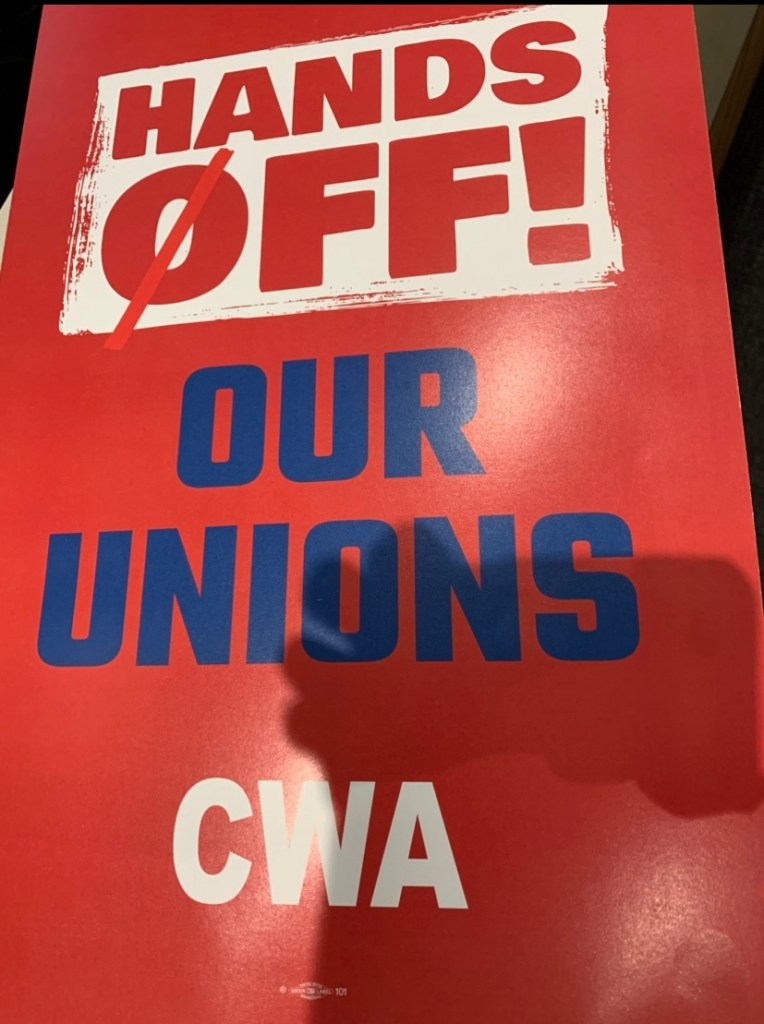
Virginia marched to the rally leading a labor feeder march that began at the AFL-CIO headquarters located across the street from the White House. Union members from the teachers’ unions, APWU, AFGE, CWA, Nurses United, SEIU, NTEU, IFPTE and others chanted through the streets: “What’s disgusting? Union Busting! and “What do we want? Worker Rights! When do we want it? Now!” and “If we don’t get it… SHUT IT DOWN!”
Liz Shuler, President of the AFL-CIO and Everett Kelley, president of the AFGE (the American Federation of Government Employees) spoke to the crowd, as did other union officials. So did several Democratic Party politicians. Maryland representative Jamie Raskin criticized Trump for his closeness to dictators like Putin, and for recent stock market declines. “No moral person wants an economy-crashing dictator who knows the price of everything and the value of nothing,” he said. But his fighting words had no direction. The Democratic Party wants to defend a system from Trump which never worked for working people, and to funnel opposition into elections.
Clarence Cooper had traveled to DC from Atlanta with an anti-DOGE sign that said on the back, “Come on, Congress, Do Your Job.” A majority of the crowd still support voting Democrat against the Republicans, even if disappointed in the choices, but, unlike the politicians, they also want something to happen now and could be a part of a united front against Trump’s cuts to programs and civil rights. Virginia said the sentiment that politicians will not save us is pervasive, and socialists must seize on it. “People are saying the Democrats have failed, it is only us on the streets who will make the difference.”
Reverend William Barber of the Poor People’s Campaign drew cheers when he told the crowd “This is way bigger than just a party issue… They are betting we will be afraid of them, but this is the time we must increase, intensify and embolden our agitation… They are afraid of your unity and your diversity, we must keep them afraid.”
On the same day, there were thousands at a separate March On Washington for Palestine, where speakers were clearer on the bipartisan nature of the attacks on Gaza.
The Women’s March, which had sparked the immense marches against Trump at the start of his first term, but seen smaller numbers so far, was part of mobilizing for the DC rally, and brought colorful banners on a range of issues.
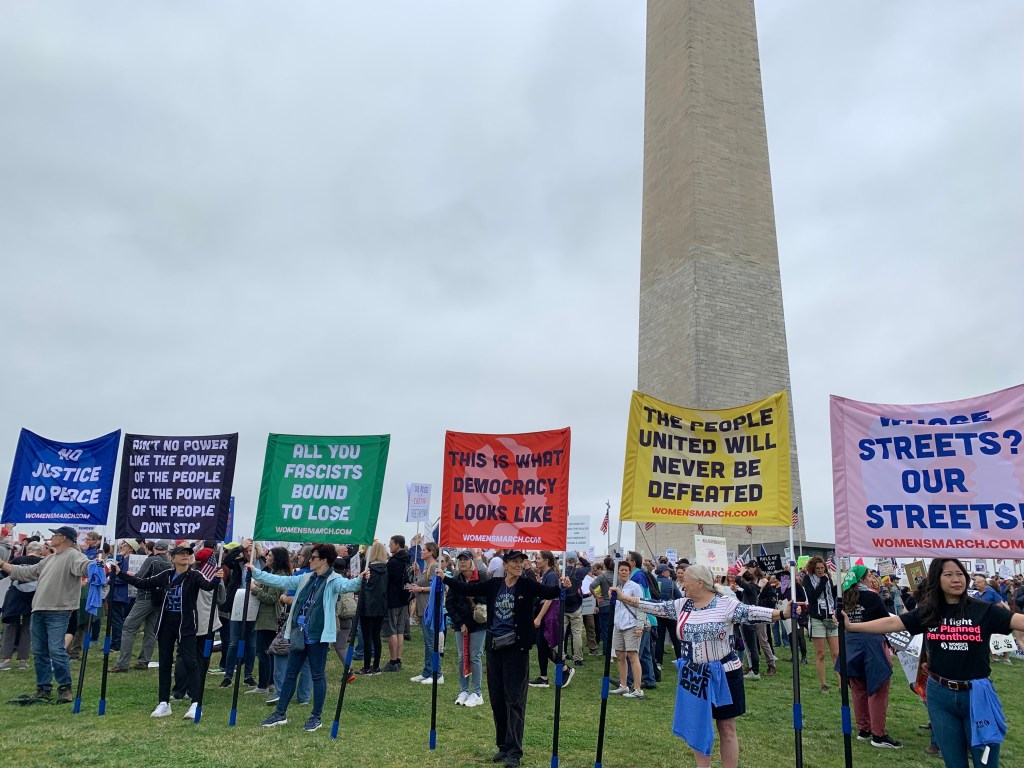
Photo Virginia Rodeno/Marx21
New York City
An estimated 100,000 protesters marched down Fifth Avenue for hours as part of the Hands Off protests. There was no stage or speakers at either end of the unpermitted march. It took an hour for crowds just to squeeze through from 6th to 5th Avenue at the start, but the crowd was upbeat and spirited in spite of the drizzle.
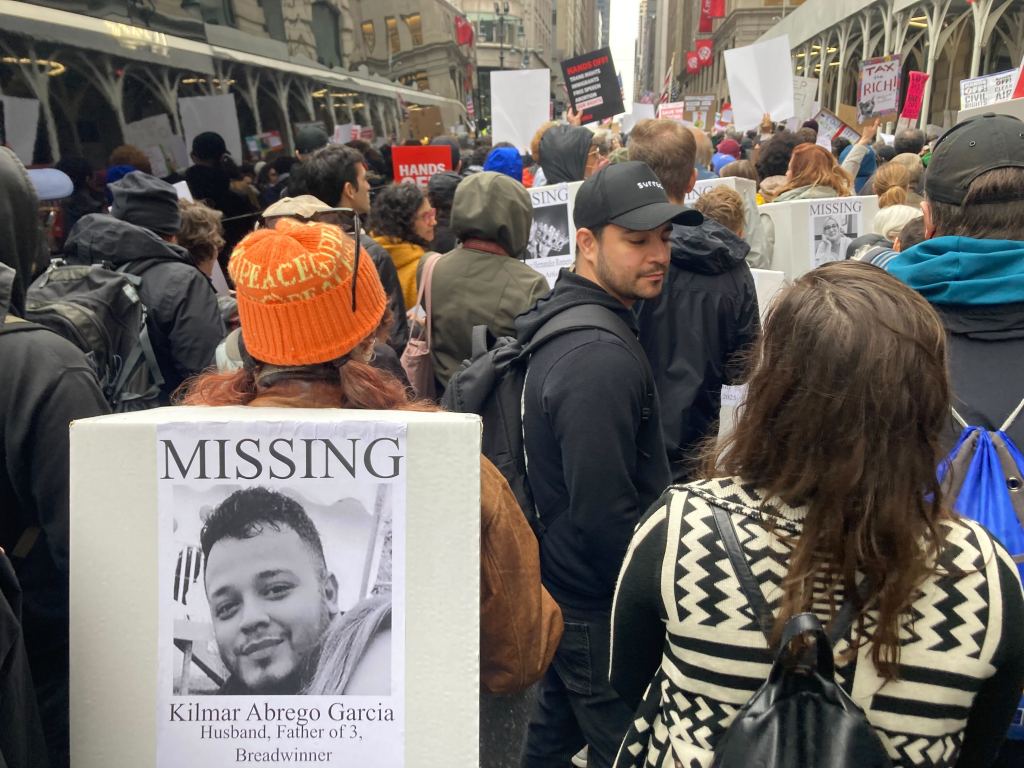
Although it didn’t have the energy of the pro-Palestinian demonstrations where constant chants would erupt and get picked up by everyone, people did chant “Hey Hey, Ho Ho, Elon Musk has got to go,” and other favorites. Eric, a socialist on the march with his son, reported that when he introduced “What Do We Do? Stand Up Fight Back!” chants about immigrants, trans kids, civil rights and union rights, they all were repeated loudly. Almost all the signs were handmade and they expressed clearly where people were at: “Stop The Billionaire Takeover,” “Deport Elon,” “Keep Your Creepy Hands Off Our Bodies.” And the general themes of: “Hands off Our Schools/ Medicaid/ Medicare/ Social Security!”
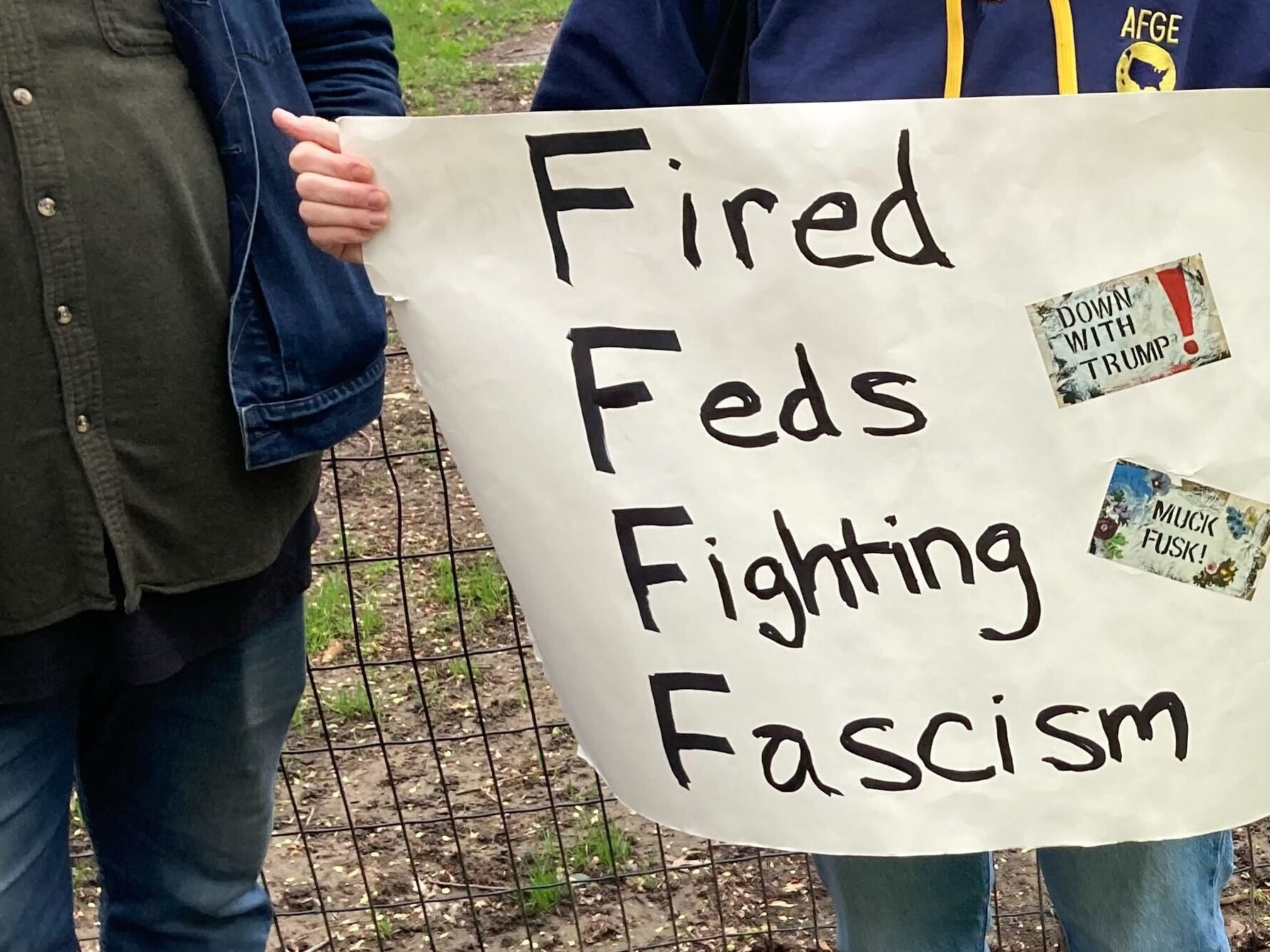
It was obvious that people were worried about jobs and the gutting of all the federal agencies that were targeted because they provide us with much needed assistance. A young woman stood with a sign that said: “Fired Fed Fighting Fascism” explained to the small crowd surrounding her that she had just lost her job at the IMLS, the federal agency that supports libraries, archives and museums. She was happy to see so many people at the demonstration. When asked what her union, the AFGE, was doing, she said she was waiting to hear the outcome of their lawsuit to invalidate the order.
The Central Labor Council endorsed the New York march. A contingent of CUNY faculty and staff with PCS union squeezed into the march on 40th street, chanting and carrying union signs. They are a familiar sight on New York demonstrations, but there were also less familiar and sizable contingents from NYSNA (NY State Nurses Association), UFT (United Federation of Teachers) and the LIUNA laborers union, CWA, and the SAG-AFTRA union – actors and entertainment workers who had received considerable community support on their picket lines last year.
With no stages and a drawn-out march, even these union contingents were lost to many in the larger crowd. Some felt it made sense not to be corralled in front of innumerable speakers. Others felt somewhat letdown at the end when we reached the park only to be told to keep moving and disperse. Despite the pro-Palestinian left groups taking buses to DC on the day, there were still signs about Palestine dispersed through the march.
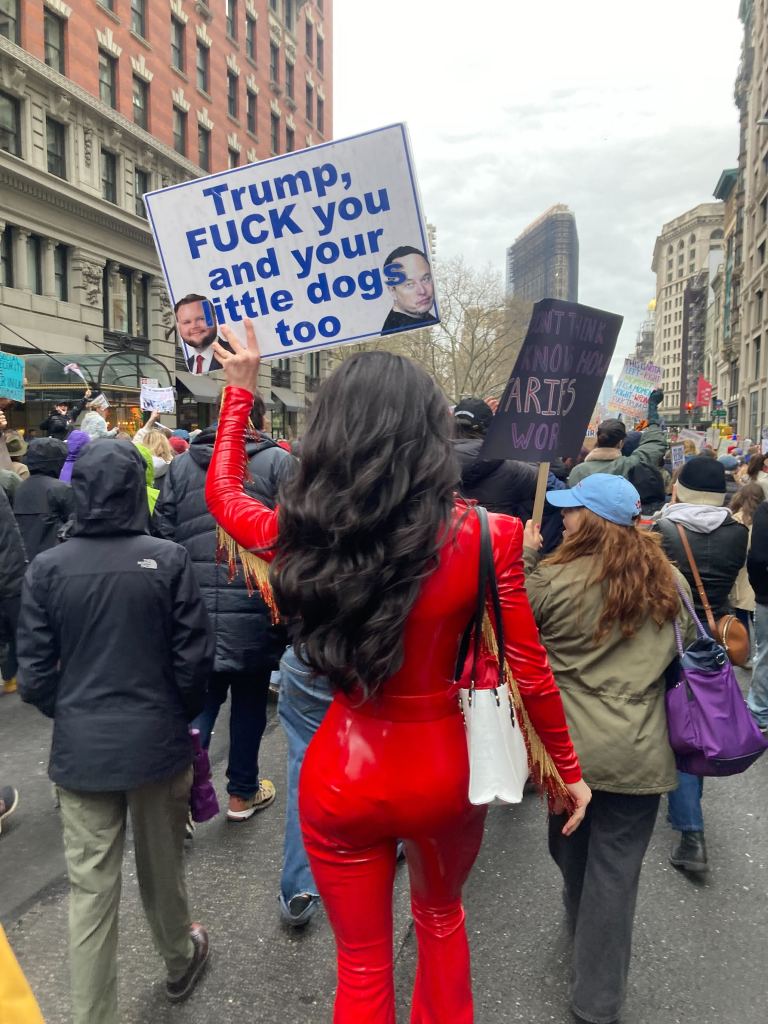
The crowd was mostly white and of a certain age, though luckily quite a few young faces were among us. Isaiah, a junior high school student, said he had come down to the demonstration from Connecticut because he knew his future was at stake, especially given the cuts in education and the way the administration wanted to control what was being taught. He bemoaned the fact that his friends were not paying attention to what was going on, but he was resolved to try to convince more of them to get involved.
Kit, a 28 year old, said he thought other young people were horrified by what was happening, but were not convinced a demonstration would make a difference. He believed something radical needed to be done.
An 80 year old woman, Madeleine, said she had never seen, in all her years of activism, anything like what was happening under this new administration. She had voted Democrat because that was always the only choice available, but she was completely disgusted with them. She saw the world spiraling out of control and going into a very dangerous place. She was coming to the conclusion that a revolution might be the only way out of the destruction facing us. It was up to us and the young people in this country (and around the world) to pick up the torch and keep up the fight.
This seems to be a conclusion shared by many more people, who are beginning to see that the reliance on the Democrats, the courts and the usual methods are dead ends when dealing with the forces of capitalism.
Arizona
Many thousands marched in Phoenix, but also rallied in smaller towns. Nathaniel, a local socialist, reports from the small border town of Bisbee:
There were around 300 people in attendance at the protest. Much of the rally expressed mainstream liberal politics, about how we need to “protect democracy.” The people I spoke to expressed a great sentiment of anti-rich and anti-austerity positions. Like the 50501 movement, there was a major focus in the rally against Trump and Musk’s DOGE policies and the need to protect Social Security, but also basic civil rights as represented in “DEI” policies.
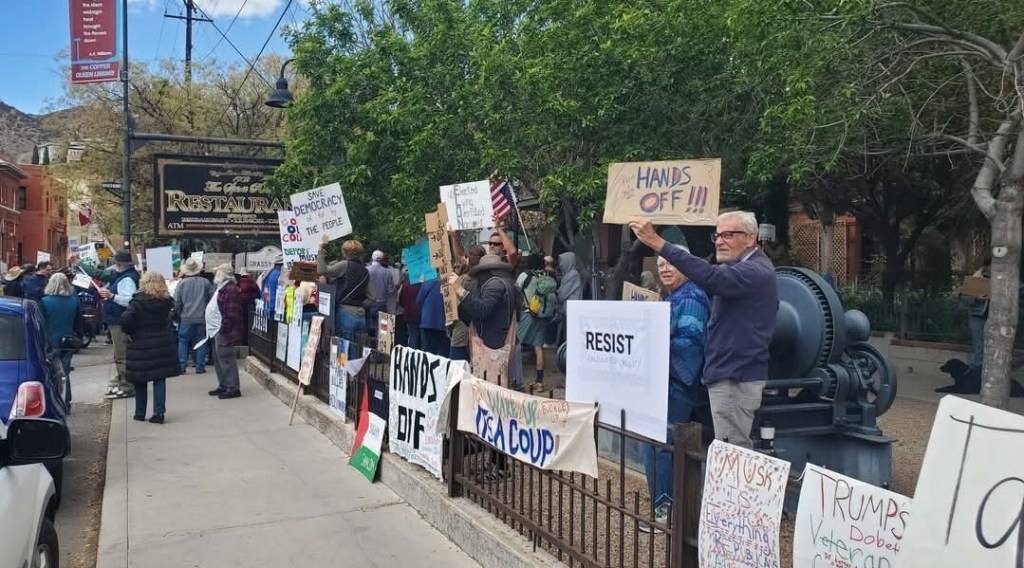
A faction of “uncommitted” activists “showed support for Palestine and gave a speech.” Nathaniel also reported talking to one anti-Zionist Jewish person from Israel who stood against that state and for a one-state solution for Palestine. They had a lively conversation about Palestinian history and radical politics.
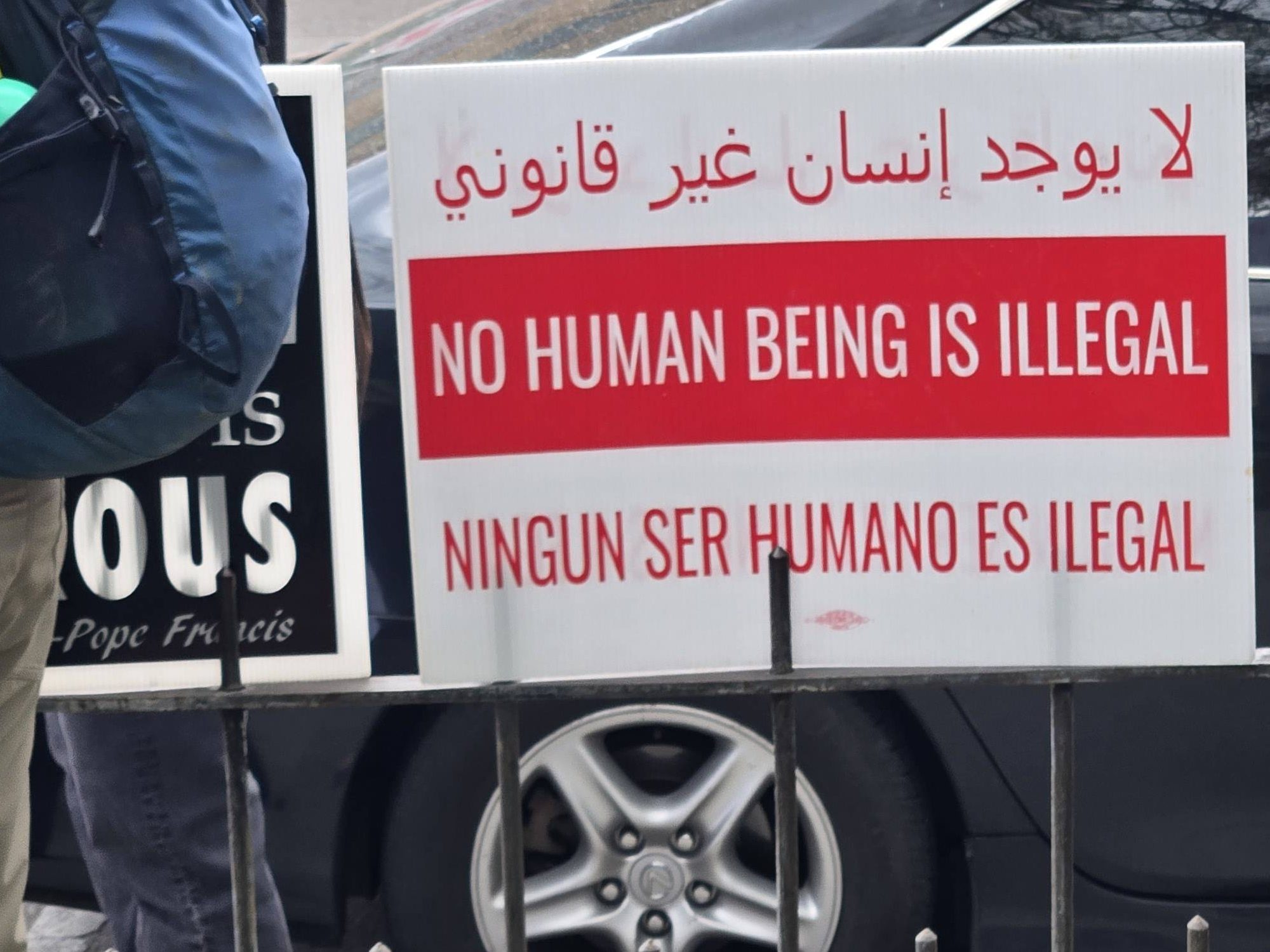
Nathaniel gave a speech on trade, condemning Trump’s tariffs, but saying the working class has no stake in capitalist “free trade” or capitalist tariffs and protectionism. Protest organizers took him aside afterwards to urge no criticism of “free trade.” Several years ago, during the protests against NAFTA or the alter-Globalization protests, a similar speech might have had organizers warn you not to speak against tariffs.
Los Angeles
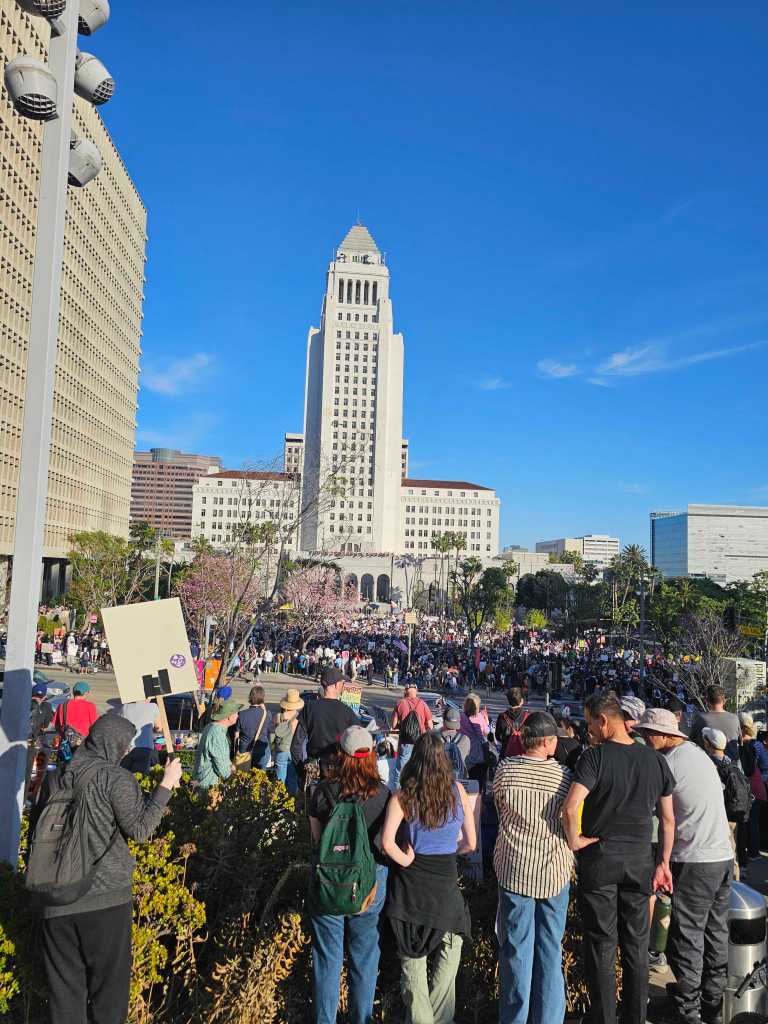
Participant Louis said demonstrations were “a fantastic day.” Photo Victor Fernandez / Marx21
Oregon
There were many small protests in rural areas and throughout the state. In Salem, the capital, Annon, noted that “Oregon may be a blue state, but it’s really a few large blue city islands in a sea of red,” and the far-right have a large presence. Despite that, there were “easily double past 50501/Indivisible events here” on April 5th. Anon described it as “a much more mainstream or centrist turnout. Much more about Social Security, DEI, anti- DOGE, anti Musk and Trump, quite a few anti-fascist type signs.” There was a broad age mix, and “more than the usual number of military veterans.” Despite a large Mexican immigrant population, there was “a noticeable lack of Mexicans in the crowd,” which was mostly white. While there were fewer Mexican flags than in previous demonstrations, several allies held signs supporting immigrant rights. They were joined by “a similar number in support of trans and LGBT rights, but they are dwarfed by the mainstream crowd.” Perhaps the fear of ICE kept some immigrants away, but mobilization through Indivisible and similar lists might also have bypassed this community. It was still good to see more people getting involved, and to see veterans marching against Trump rather than for him.
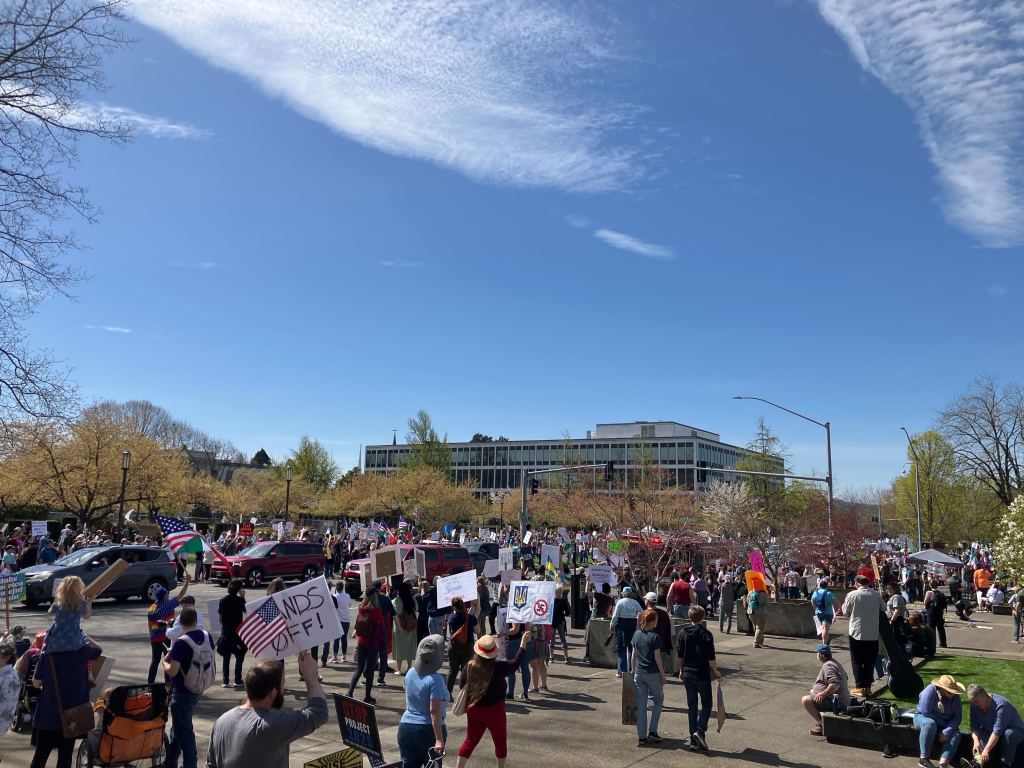
Bowling Green, Ohio
There were 58 Hands Off protests in Ohio, in Democratic and Republican leaning areas of the state.
About 600 showed up in Bowling Green, stretching down Main Street in the drizzling rain. Hand-made signs variously said “Hands off…” our neighbors, the VA, Social Security, etc. Cassie, a young protester, told Marx21 the turnout was great for such a small city. “Besides the usual leftists, there were lots of country people and veterans hating on rich people. It was sick!” A retired teacher said it was his first demonstration, but “our country’s in trouble” and it is “time to speak up.” One sign, in the trans colors, read “you are focused on the wrong 1%.” Cassie brought socialist flyers, and handed out 40 in the first 10 minutes.
Democratic Party is Not part of the Answer
During Trump’s first term, leading Democrats attempted to hijack activist opposition, calling themselves “part of the resistance.” This time they are largely avoiding that strategy, waiting for overreach and elections in the mid-term or four years from now. Democratic strategist James Carvell has advised the party to avoid “politically charged positions” like DEI, and “roll over and play dead,” expecting “Republicans to crumble beneath their own weight.” Many Democratic officials have been tailing Trump’s hateful views on immigration and trans people, and there was vast anger at minority leader Chuck Shumer for agreeing to the MAGA budget in the Senate.
Multiple polls in the last months have shown record negative approval ratings for the Democratic Party. But Jamie Raskin still received applause, and several protesters carried signs supporting Cory Booker after his 25 hour anti-Trump speech.
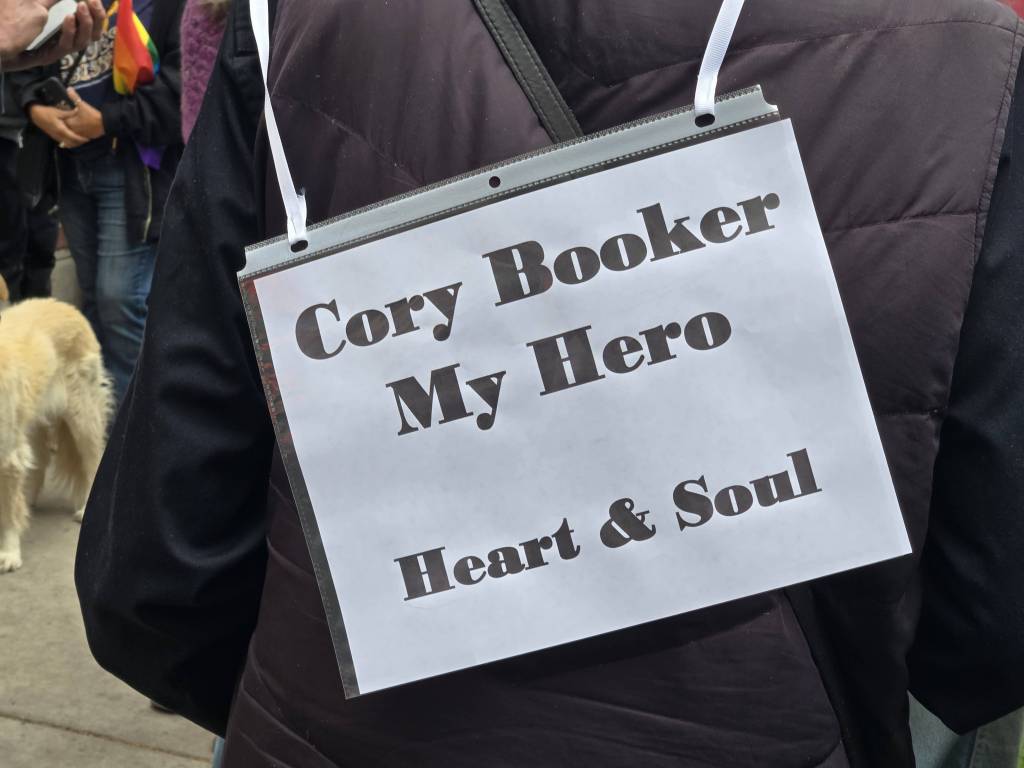
However, Booker did not mention the genocide in Gaza in those 25 hours, and a few days after his speech, Booker voted against resolutions proposed by Bernie Sanders to block $8.8bn in new arms sales to the Netanyahu government.
The Democratic Party wants to defend the liberal capitalist order and US imperialism against Trump, even when that system has failed millions of people in the US. And even that defense has already retreated to the right on many points.
That does not mean they won’t attempt to jump in front of the movement again as it continues to grow.
In DC, Ilhan Omar spoke pointedly against not just the range of cuts, but billionaire influence, against the ability to “snatch people in the middle of the night and disappear them,” and even mentioned trans kids. But even she addressed the crowd as “American patriots,” and bracketed her speech with references to “the marvelous constitution we have.” These officials (like the speaking tour of Bernie Sanders and Alexandria Ocasio-Cortez), who give a better speech than most Democrats but have little influence on the official stance of the party, should not be used to funnel resistance back into that party.
Next Steps
Everyone knew that one march by itself would not change the situation, but there has never been a successful mass movement that did not include mass marches.
As the rallies were wrapping up, Rahna Epting, Executive Director of the Democratic-leaning MoveOn, said “This peaceful movement is powered by everyday people—nurses, teachers, students, parents—who are rising up to protect what matters most. We are united, we are relentless, and we are just getting started.”
If this mobilization is really to continue as a movement, it will need the ability for people to take part in ongoing democratic organizing spaces. As Keeanga-Taylor spoke recently about the demonstrations, they are a good place for people to realize we are many, they are few, and gain confidence. But it is not enough to ask participants to go home and wait by your computer for the next call to mobilize.
The next large nationwide rally is April 19. The group 50501 (www.FiftyFifty.one) has a list of events near you. But more important is May Day, where union and community groups have been organizing for more militant actions.
The last tab at the “Hands Off” website links to MayDayStrong.org, inviting people to join the next May Day organizing call on April 17. This national organizing, called in particular by the Chicago Teachers Union, is aiming at building for a general strike initially floated by UAW, as well as other coordinated labor actions leading up to that date. They include a day of action with other groups this May Day, 2025.
Already in Chicago immigrant rights groups, the Chicago Teachers’ Union, and other union and community groups have organized a rally and a week of actions, including work stoppages. Other cities are in various stages of planning.
April 5th shows how opposition to Trump presents an opportunity for uniting struggles, and creating a broad united front. It is important that 1) it not be confused with popular mobilizations led by Democratic Party politics, 2) it focus on involving the strength of the working class, especially organized workers and immigrant workers, and 3) it include a socialist voice which can argue for a real alternative to the system rightfully rejected by masses of people. Get involved.
 Marx21 US