
By Marie Edwards, with input from Eric Fretz in New York.
Amazon workers in seven facilities, organized under the Teamsters’ banner, went out on a limited strike Thursday morning December 19, and maintained picket lines till Christmas Eve.
The picket line we visited in Queens, NY, on a very cold Saturday morning, was lively and well attended. Other sites went out in Georgia and Illinois, five in California, and on Saturday morning workers at the JFK8 facility in Staten Island joined the strike. The Teamsters are calling this the largest strike at Amazon ever, and claim “The Teamsters Union represents nearly 10,000 Amazon workers at 10 warehouses and delivery stations.” This includes the 5,500 at Staten Island’s JFK8, the only facility to have won a union election. This is still only about 1% of Amazon’s hourly workforce, and none of the eventual nine facilities affected were shut down by the strikes. But, despite Amazon’s claims, deliveries were delayed and the coordinated event should be seen as a milestone, and an important step for continued organization.
The Staten Island facility had first been organized under the independent Amazon Labor Union in April 2022. But it was not able to secure a contract against Amazon’s stonewalling, and eventually voted to join with the Teamsters in September of this year. Amazon is using the courts to challenge both the union and the switch from ALU to the Teamsters, despite 98.3% voting to do so.
In other sites, where some workers have signed cards with the Teamsters but there is no recognized union, workers are legally protected against retaliation by US law on “concerted activity” around certain workplace issues, in this case, protest against the Unfair Labor Practice (ULP) of Amazon refusing to bargain.
Maspeth Picket Line
The picket line we visited at the huge fulfillment center in Queens had around 100 people, strikers and supporters together holding teamsters signs, demanding that Amazon stop its unfair labor practices and sit at the table with the union.
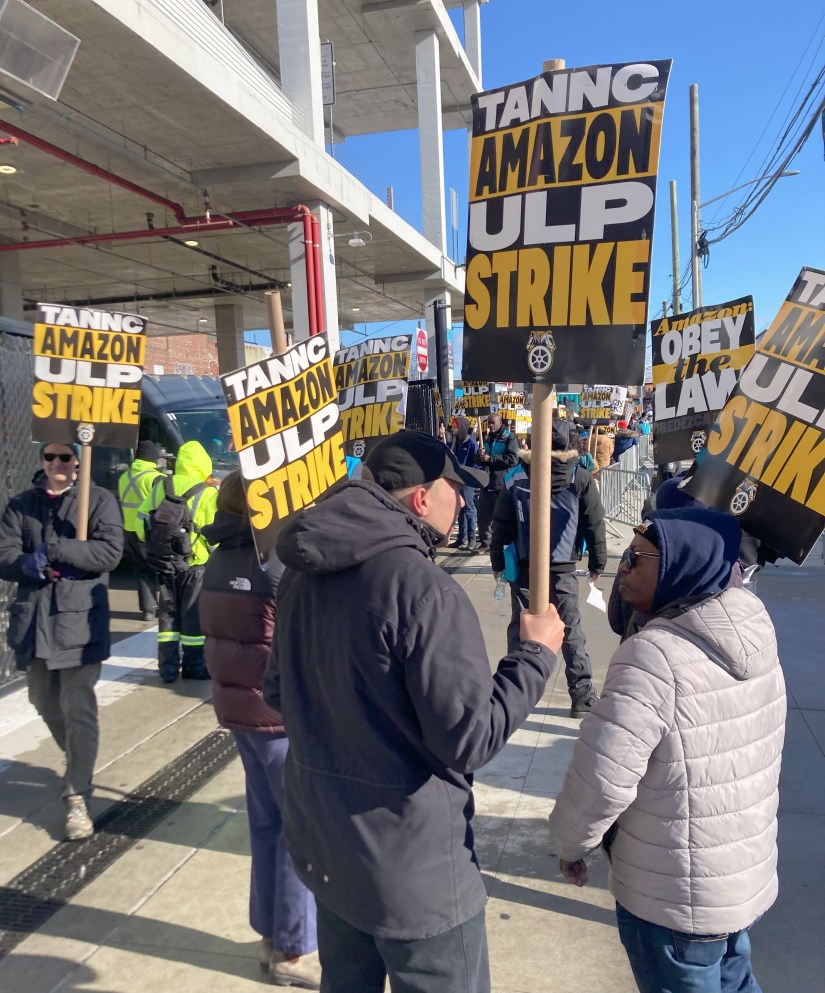
Most of the strikers on the picket line were drivers, but there were some warehouse workers, and they were joined by other Teamsters members and organizers and others showing solidarity, including a few DC37 members. The strikers told us that many more supported the strike but were afraid to come out because of fear of retaliation.
Warehouse workers at this Queens location had been organizing with the independent Amazonians United before drivers began to join the Teamsters.
The Teamsters’ strategy was to try to delay the Amazon delivery vans leaving the facility by marching in front of the exit. One striker told us they let a certain amount out every five minutes, as blocking them altogether would lead to the police forcefully removing the picket. Just a day earlier, the police attacked the picket and arrested two picketers and then threatened mass arrests before breaking the line to allow vans through. Another driver told Marx21 that to really be effective the picket should be blocking the large delivery trucks ENTERING the facility. He recognized this would eventually demand a much higher level of struggle.
The delivery drivers we talked to were officially employed by contractors, known as Delivery Service Partners (DSPs), though they were quick to insist they were really Amazon workers. They drive vans with the Amazon logo, they wear Amazon uniforms and have to follow Amazon rules. But Amazon claims they are not responsible for their working conditions, and don’t have to bargain with them. As labor academic David Weil told Labor Notes in June, “Amazon wants to have it both ways: total operational control but no employment responsibility.”
Everyone agreed the work is grueling: a 10 hour day, with an (unpaid) hour for lunch, which most often gets skipped because of the ever growing number of parcels to be delivered on a shift, especially during peak times, like the end of year holidays or on Prime Day. One striking driver with two years on the job and major back problems explained, you might be given a hundred parcels to deliver daily. What counts as a parcel might be a small envelope but most likely, parcels are quite large, especially now since Amazon has started to group smaller items together into one box.
Another driver on the picket line, with only three months on the job, explained how Amazon relies on competition between the different DSPs to pressure the drivers by setting impossible goals and secretly breaking safety agreements. The DSPs get paid per package delivered and worry they might lose their contract if they fall behind. Drivers also worried about having their days cut if they delivered less than other drivers.
Vans are supposed to be given an (90 second) inspection after a shift and would be taken out of service for repairs if there was a problem. DSP management therefore prefer to “deal with it” themselves and allow the van back out. For example, the driver was told to roll down a broken window so that it wouldn’t be noticed. This driver was upset not just because of the pressure and its effect on his health, but because the system affected customers too. Knowing you can’t do a good job, having to leave packages in the rain or to fudge notifications to fill your quota “changed you from the inside out.” He said all the drivers in his DSP complained about conditions, but only six of about 30 joined the strike, afraid they would be fired or have their hours cut.
Why Amazon ?
Amazon has long been a very obvious choice for organizing. Not only is its executive chairman Jeff Bezos one of the richest men in the world with a net worth of over $230 billion, but the company itself has had some of the worst labor practices in the US. Working conditions are extremely grueling, and often quite dangerous, for drivers and delivery workers, and especially for warehouse workers. Examples abound of workers sustaining injuries while picking, packaging and shipping orders in the warehouses, with the increased pace caused by ever-higher production quotas. According to a study by the University of Illinois, Chicago, 41% of Amazon workers have been injured on the job, and 69% took unpaid time off to recover from pain or exhaustion caused by the job. Even when fined by the Occupational Safety and Health Administration (OSHA), the fines barely register as a percentage of Amazon’s total worth of 2.4 $ trillion.
In terms of pay, Amazon warehouse workers make on average 18% less than other warehouse workers in counties where it does not operate. One study concluded that having an Amazon warehouse located in a county depresses the wages in that county by roughly $822 a month. In fact, roughly half of frontline warehouse workers at Amazon are having trouble making ends meet, a new report shows, even after having their hourly wages raised to $17/hour in September 2023.
Anger at this pay and grueling conditions is palpable not only on the picket line, but throughout the workforce. The 4-day strike in those facilities organized by the Teamsters therefore carries great significance. Victory will be difficult against this behemoth which spends millions on union busting, breaks labor laws with impunity, has annual staff turnover rates of over 100%, uses advanced technology on worker surveillance, and can re-route deliveries from struck fulfillment centers, and even absorb limited losses by closing down contracts with unionized shops. But the more unionization spreads the harder it is to isolate, and Amazon’s regional distribution centers are especially vulnerable “choke holds” in its system of rapid deliveries. This will take creativity and initiative in ground up organizing, building on local grievances. But it will also take the resources and coordination the large Teamsters union can provide. Activists must be careful the Teamsters campaign does not resemble the SEIU’s “Fight for 15” strategy of staff supplementing a handful of workers at pickets that are aimed at publicity, not shutting down the business. But pictures of Amazon workers confidently on picket lines around the country is a help in getting more workers and more sites involved, just as the unsuccessful attempt by RWDSU at the Amazon in Bessemer AL helped inspire organizing elsewhere.
Strangely enough, both Amazon’s Jeff Bezos and the Teamster’s president Sean O’Brien are hoping to influence Trump for help in the battles ahead.
Organizing Under the New Trump Administration
Amazon is banking on more anti-labor rulings in the Trump administration, both filing with the NLRB against the vote in Staten Island, and challenging the NLRB as unconstitutional in federal court, a suit which could end in the right-wing Supreme Court and fundamentally shake up US labor law.
However, Bezos has criticized Trump in the past as eroding democracy, and Trump has verbally attacked the Bezos-owned Washington Post, Amazon’s effect on small business, and Bezos himself. Not wanting to be on Trump’s bad side (he has billion dollar federal contracts as well as union issues), Bezos intervened in the Washington Post’s editorial process to stop them from publishing an endorsement of Harris, and recently joined with other tech figures attempting to befriend the next president.
On the other side, the Teamsters were one of the unions who did not endorse Kamala Harris, and Sean O’Brien broke precedent by being the first union head to speak at the Republican Convention. As Marx21 has detailed, Trump, capitalizing on the Democrats’ avoidance of class politics and the effects of inflation, was able then to pose as a friend of the overlooked (white) working class.(Of course, Trump tried to align American workers and American small businesses against immigrants and Chinese trade, rather than workers vs bosses). But many thought O’Brien was using all the above in a wrongheaded strategy to get Trump to at least remain neutral on the drive to unionize Amazon.
Not to be outdone, Bezos now claims to be “very optimistic” about a second Trump administration, has sat down to dinner with Elon Musk at Mar-a-Lago, and had Amazon donate a million dollars for Trump’s inauguration.
Union officials who think they have befriended Trump may be unpleasantly surprised.
Solidarity
There are a number of major union contracts expiring in 2025, with the potential for strikes and exposing which side Trump is on to his working-class voters. Successful strikes anywhere, or even the rebirth of resistance to Trump’s agenda, will help ferment a mood of militancy. If the resources of the Teamsters can continue to support and link up struggle in individual units, Amazon can again be a focus of class struggle. In any case, building shop-floor strength by the workers themselves will be key, either in independent unionizing efforts or networks of rank-and-file militants inside the still bureaucratically led Teamsters union.
 Marx21 US