This Friday morning, 9/29, as the UAW auto strike entered its third week, union president Shawn Fain announced its expansion would be limited to two new plants: Ford Chicago Assembly (which makes the Ford Taurus and Lincoln MKS) and GM Lansing Delta Township, involving an extra 7,000 workers. A nearby stamping shop in Lansing will stay working.
Hitting the especially profitable Ford Kentucky Truck Plant, or profitable vehicles like the GM Chevrolet Silverado or Stellantis Ram, would have landed a bigger blow, but they are still running. If sites that produced engines were struck it would also have a greater knock-on effect on other assembly plants.
The gradually expanding strike against the Big Three automakers started on Sept. 15 with almost 13,000 workers at just three plants. On the second week, 38 parts distribution centers for Stellantis and GM were called out, creating picket lines at 41 locations in 21 states. These centers tend to be smaller, so they only brought an extra 5,500 workers out. They have all been welcoming of solidarity. Lack of parts will have some knock-on effects, but they supply service centers and dealerships, not production facilities. Importantly, the 38 locations are spread around the country and many are close to big cities, increasing visibility and opportunities for solidarity. So too are the Chicago and Lansing plants.
At the start of the strike Fein told members “winning these demands will take all of us, fighting together.” But even after today there are just 25,000 striking out of the 150,000 UAW auto workers. For this strategy to win its major and legitimate demands there will need to be significant expansion, and the threat of more.
US auto plants are highly dependent on overtime. In his announcement, Fain called on the majority of members still working to keep refusing voluntary OT, making official an impressive initiative that started locally from below. The reform caucus Unite All Workers for Democracy (UAWD) had distributed a pledge to refuse voluntary overtime and helped workers on the shopfloor coordinate a “work to rule.” This shows the readiness of workers to get involved, though Fain also insisted that workers who were not called out (now working without their expired contract’s no-strike pledge) stay on the job.
Last week no Ford locations were called out, as the company had made more concessions in negotiations than the other two, but it was still far away on basic pay. This is despite Ford CEO James Farley’s total compensation rising to $21 million in 2022, and the company spending over $4.3 billion on dividends since November–including a special dividend this February–benefiting executives and investors. It is right Ford was included in today’s announcement, but this week Stellantis was excluded from the new call out as they apparently made offers on cost of living adjustments (COLA) and right to strike over plant closures immediately before the announcement. Yet, like Ford, the offers are partial and don’t cover an adequate increase in pay.
After the 2008 recession the union granted some concessions, the hated lower tier was introduced, and COLA was taken away. Auto manufacturing workers have seen their average real hourly earnings fall 19.3 percent since then. But the Big Three have seen profits of $250 billion over the last decade. When the companies used the pandemic to raise prices, profits soared by 65%. Instead of compensating workers and investing in electric vehicles (EVs) they authorized $5billion in stock buybacks in 2022. It’s past time to reverse all those concessions and win a major above inflation wage increase!
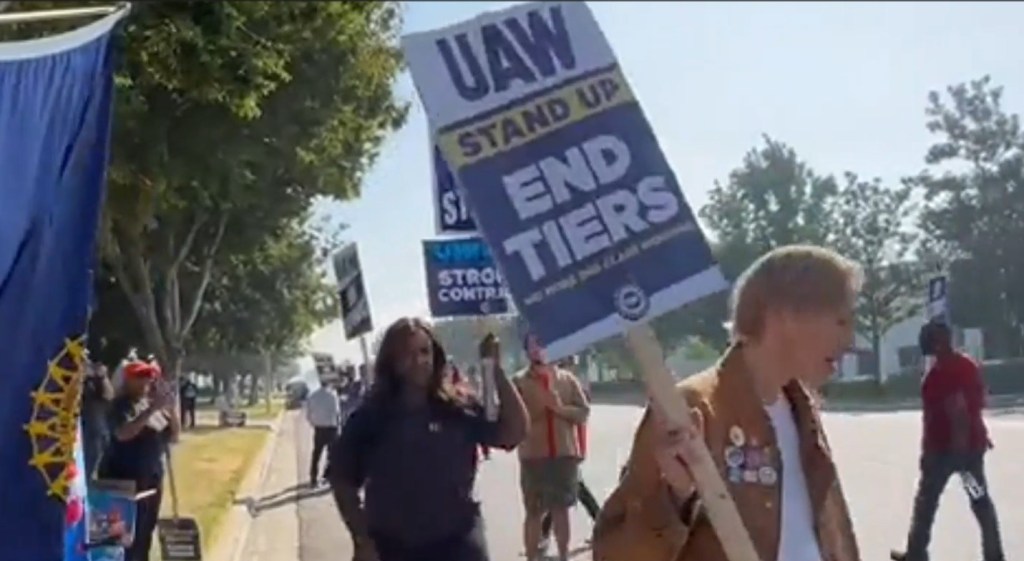
On this strike UAW has made eliminating tiers a major demand. “End Tiers” means not just bringing up the pay of post-2007 workers in assembly plants to match their colleagues, but bringing them off the risky 401ks into the defined benefit pension plan, and bringing up the salary of other workers to those in the larger plants.
Desperate for unearned votes in the swing state of Michigan, both main presidential candidates briefly showed up Wednesday. Trump spoke at a non-union auto parts plant, using nationalism and opposition to electric vehicles to undercut class politics, saying the current strike “doesn’t make a damn bit of difference” and his second presidency would be “patriotic protectionism.” Biden, after breaking the national rail strike before it began, had the gall to appear on a UAW picket line and pretend to be on the side of both the workers and corporations, wishing for a “win-win” settlement. The only thread of legitimacy Trump had was that Biden had been giving vast subsidies to automakers retooling for EVs, without stipulating they be union jobs or at equivalent pay.
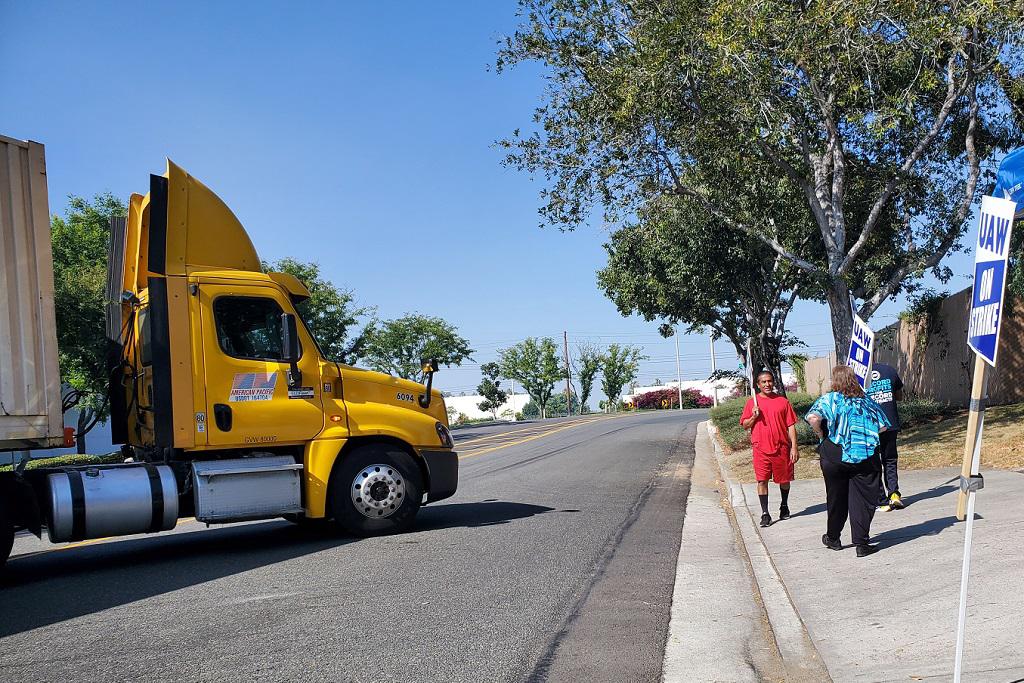
But most people are not falling for any of it. The UAW and WGA / SAG-AFRA strikes have increased popular support for unions, with 2/3 of Americans supporting the UAW and only 19% of the auto companies. It is the clear class politics shown in strikes, and confidence produced by a victory, that will best undercut the hateful and divisive rhetoric being pushed by the far-right, whoever is in the White House. This rhetoric has consequences: while picket lines have seen overwhelming support, there have been several instances of violence against picketers, including assault by car or truck, and a gun being pulled on picketers in a Los Angeles area picket.
Bringing the workers who make EVs and batteries into the same contract would also be a big step for a just transition, and undercut right-wing arguments against cutting fossil fuels. There is not a contradiction between the environment and workers’ power. The contradiction is between the environment and the race for profit. A victory for the UAW now would also help revive the unionization of unorganized auto plants in the US south, after several half-hearted and unsuccessful tries.
Teamster drivers have respected picket lines all across the country, but in a few locations picketers have had to mobilize to block non-union scab drivers, and could use unofficial assistance. The UAW is also calling on groups of supporters to canvas Big Three dealerships, and has produced this toolkit to help.
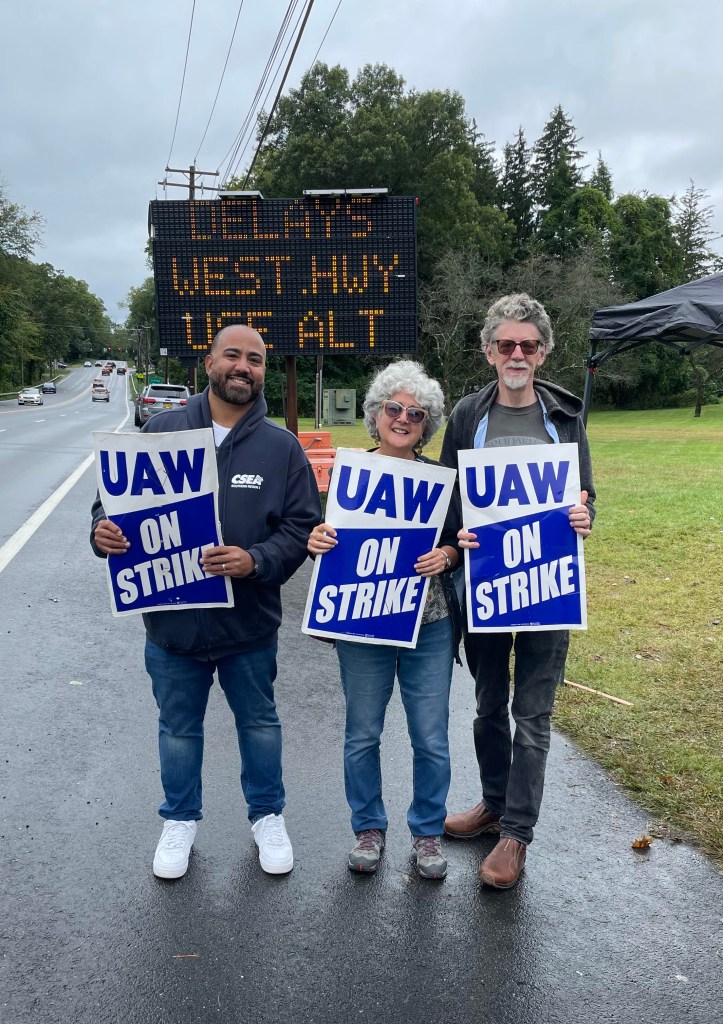
UAW chartered a bus to bring supporters to picket lines near Toledo Ohio. In New York City, the UAW has paid for a bus tomorrow to bring solidarity visits to a striking Stellantis parts distribution center (PDC) an hour away. Last week workers there were solidly in support of the strike, of mixed opinions on the strategy of partial but expanding strikes, and very welcoming of solidarity on the picket line. Many complained of the extensive compulsory overtime on the job that takes them away from their families. These PDC workers are on a lower-paid tier, though the profit margin on spare parts is still 30-40%, collectively bringing in billions in revenue for the companies. Initiatives to bring solidarity to the PDCs and striking factories should be multiplied, along with the number of striking sites. See you on the picket line!
See the map of striking locations.
 Marx21 US